
Why Most Job Seekers Don't Know What's Actually Holding Them Back
Most job seekers know they're not getting the results they want. Far fewer know why. Without visibility into your process, every problem looks the same—and every solution becomes a guess. The first step to improving your job search is understanding where it's actually breaking down.

When a job search isn't producing results, most people immediately start looking for something to fix.
Maybe the resume needs work.
Maybe they need to apply to more jobs.
Maybe they need better interview answers.
Maybe the job market is unusually difficult.
Sometimes those explanations are correct. Often they're not.
The challenge is that most job seekers are making decisions with very little information about what's actually happening inside their own process.
Imagine trying to improve a sales pipeline without knowing how many leads you're generating, how many conversations are happening, or where opportunities are being lost. Most businesses would never operate that way. Yet that's exactly how many job searches are run.
Applications are submitted.
Emails are exchanged.
Interviews are scheduled.
Follow-ups are sent.
Weeks pass.
And when progress slows down, the response is usually to work harder rather than understand what happened.
The problem with this approach is that different problems require different solutions.
If you're getting interviews but not advancing, the issue is probably not the number of applications you're submitting.
If you're getting application views but few interview requests, the issue may not be interview preparation.
If opportunities are consistently going silent after a certain stage, sending more applications doesn't address the underlying problem.
But without visibility, every problem looks the same.
It simply feels like "the job search isn't working."
This is one of the reasons job searches become so frustrating over time. Effort increases while clarity decreases. More applications are submitted. More opportunities enter the pipeline. More information accumulates across email inboxes, spreadsheets, notes, and job boards.
Yet the actual process becomes harder to understand.
Many job seekers can tell you how many jobs they've applied for this week.
Far fewer can tell you:
- How many applications are awaiting a response.
- Which opportunities need follow-up.
- Which roles generated interviews.
- Which types of positions consistently receive engagement.
- Where opportunities are most frequently stalling.
Those are the kinds of questions that reveal where improvement is needed.
Without those answers, most job search decisions become educated guesses.
And guessing is rarely an efficient way to improve outcomes.
The strongest job searches operate differently.
They create visibility.
They make it possible to see where opportunities are entering the process, where they're progressing, and where they're breaking down. Instead of relying on assumptions, they rely on evidence.
That evidence changes the conversation.
Instead of asking, "Should I apply to more jobs?"
You can ask, "Why are these applications not progressing?"
Instead of wondering whether your resume is working, you can look at actual outcomes.
Instead of assuming opportunities disappeared, you can identify exactly where they stopped moving forward.
This doesn't eliminate the challenges of job searching.
It does eliminate a significant amount of uncertainty.
And uncertainty is often what causes people to make the wrong adjustments.
The irony is that most job seekers don't need more effort.
They need more visibility.
Because you can't improve a process you can't see.
That's one of the ideas behind Trackplicant.
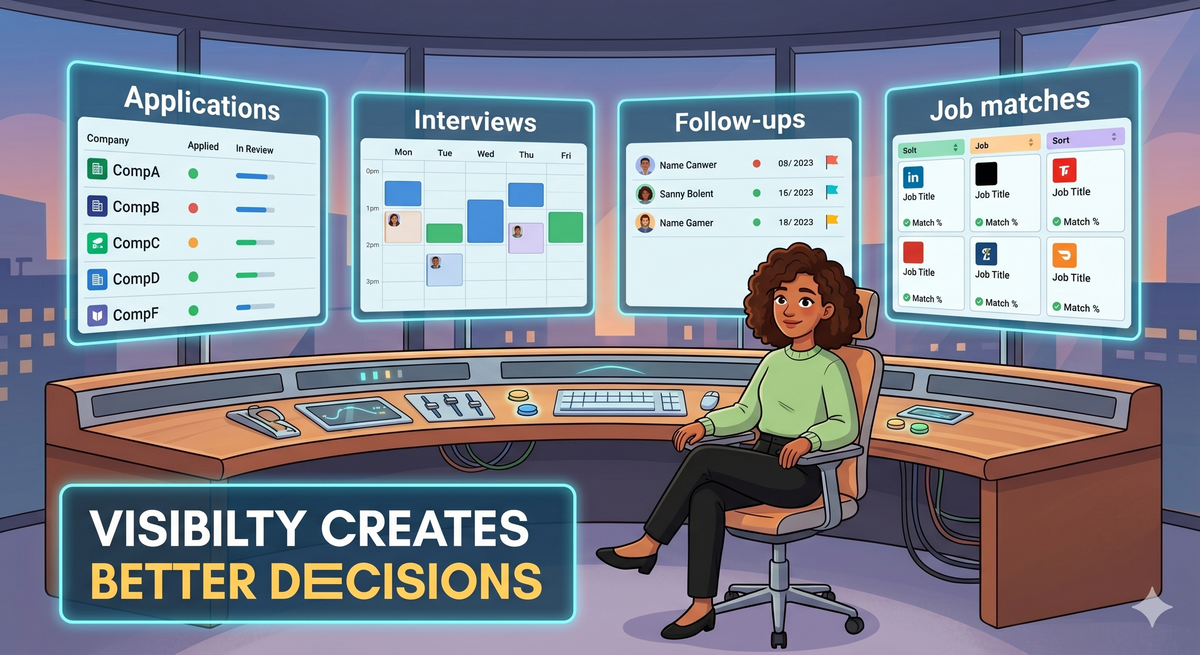
The goal isn't simply to help people submit applications. It's to help them understand what's happening throughout the entire job search process. When opportunities, follow-ups, interviews, and outcomes are visible in one place, improvement becomes much easier.
Not because the process changes.
Because the blind spots disappear.
Before changing your resume, applying to another hundred jobs, or completely rethinking your strategy, it's worth asking a simpler question:
Do you actually know where your process is breaking down?