
Why Most Interview Advice Doesn't Actually Help
Most interview advice is designed to help everyone, which means it rarely helps anyone prepare for a specific role. The strongest candidates don't prepare for interviews in general—they prepare for the interview they're actually about to have.

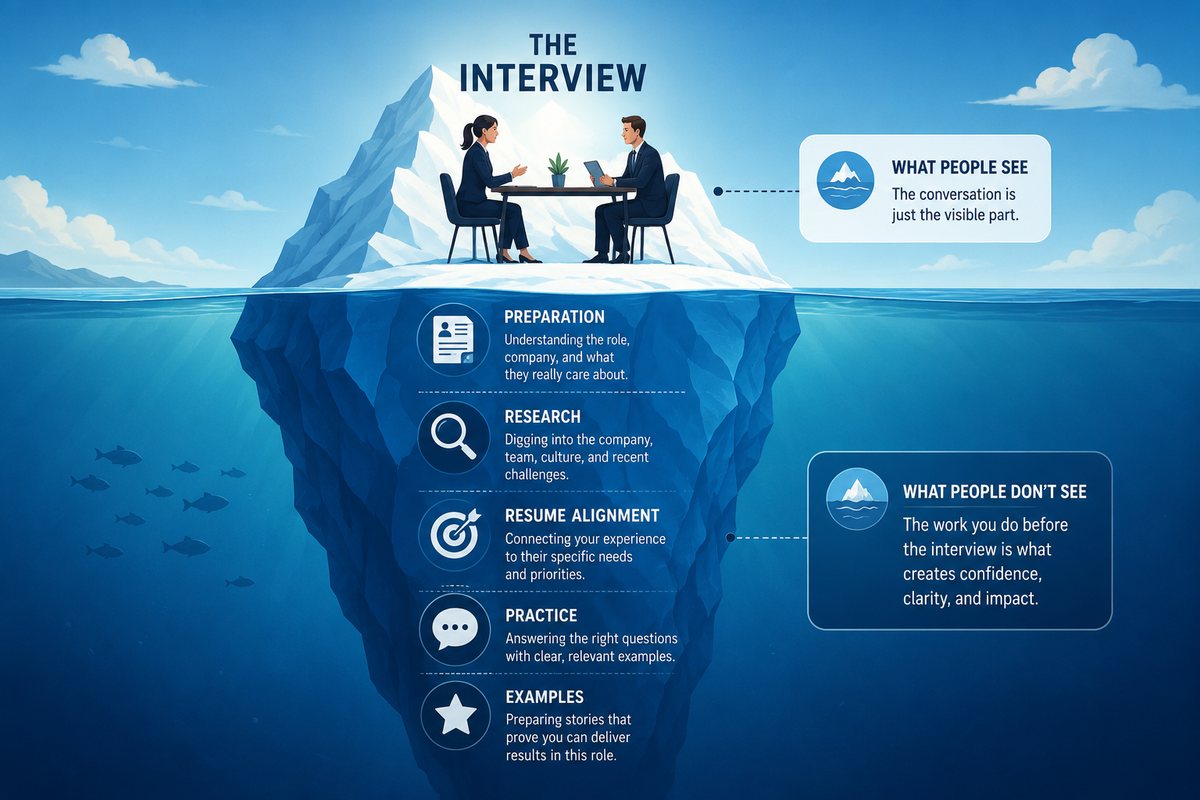
If you've ever searched for interview advice online, you've probably noticed something strange.
Every article seems to say the same thing.
Research the company. Practice common questions. Prepare examples. Dress professionally. Ask thoughtful questions at the end of the interview.
None of this advice is wrong. In fact, most of it is perfectly reasonable. The problem is that it's also the exact same advice being given to every other candidate applying for the same role.
And that's where it starts to lose value.
The internet is full of interview guidance because interview preparation is important. But most interview advice is designed to be universal. It has to work for software engineers, project managers, nurses, sales representatives, warehouse supervisors, accountants, and hundreds of other professions. The broader the audience, the more generic the advice becomes.
The result is that candidates spend hours preparing for interviews in general while spending very little time preparing for the interview they're actually about to have.
That's a subtle distinction, but it's an important one.
A hiring manager isn't evaluating your ability to answer generic interview questions. They're evaluating whether you're the right person for a specific role. They have a particular set of responsibilities they need covered, problems they need solved, and skills they need demonstrated. Every question they're asking is connected to those objectives.
Yet many candidates prepare as though interviews are interchangeable.
They memorize answers to common questions. They rehearse a brief summary of their background. They practice telling the same stories they've used in previous interviews. Then they walk into a conversation that is focused on a completely different set of priorities.
When that happens, the candidate isn't necessarily unprepared.
They're simply preparing for the wrong thing.
It's similar to using the same resume for every application. The resume might be well-written. It might accurately represent your experience. But if it isn't aligned to the role you're pursuing, it becomes harder for an employer to see why you're a strong fit.
Interview preparation works the same way.
The most effective preparation isn't focused on interviews as a category. It's focused on the role, the company, and the specific conversation you're likely to have.
Consider two project management positions. On paper, they might appear nearly identical. In practice, one company may care deeply about stakeholder management and executive communication, while another is focused on process improvement and operational efficiency. A candidate who prepares for "project management interviews" broadly may miss those distinctions entirely.
A candidate who prepares for that role is far more likely to succeed.
The difference isn't intelligence or experience. It's alignment.
When preparation is tied directly to the opportunity, everything becomes easier. Your examples become more relevant because they're chosen to address the responsibilities in the job description. Your answers become more precise because they're framed around the employer's priorities. Even confidence improves because you're no longer trying to improvise connections between your experience and the role in real time.
Instead, you've already done that work.
This is why strong interview performance often looks effortless from the outside.
The candidate isn't necessarily more qualified. They simply understand what the interview is trying to evaluate and have prepared accordingly.
Unfortunately, most interview advice doesn't help candidates get there because it remains focused on broad concepts rather than specific situations. It teaches techniques rather than context. It provides answers without helping candidates understand the questions they're likely to face.
And context is what matters.
The closer your preparation gets to the actual role, the more useful it becomes. The further away it gets, the more it starts to resemble generic advice that everyone else has already received.
That's exactly why we built Role-Specific Mock Interviews into Trackplicant.
Instead of practicing generic questions that could apply to anyone, candidates can prepare using questions generated from the actual job description and their own resume. The goal isn't to memorize answers. It's to create the kind of preparation that reflects the reality of the opportunity they're pursuing.
Because successful interviews aren't usually won through better generic advice.
They're won through better preparation.
The best candidates don't prepare for interviews.
They prepare for their interview.