
The Biggest Mistake Job Seekers Make After Landing an Interview
Most job seekers spend weeks preparing applications and only hours preparing for interviews. The problem isn't effort—it's that interview preparation is often generic when it needs to be role-specific. A great application gets you the interview. A great interview gets you the job.

Most job seekers think of the interview as the finish line.
After weeks of searching, applying, tailoring resumes, and waiting for responses, an interview invitation feels like confirmation that the hard part is over. Something worked. Progress is finally happening.
In reality, the interview is not the end of the application process.
It's the beginning of a completely different stage.
The challenge is that many candidates continue approaching the interview the same way they approached the application. They rely on general preparation, broad knowledge of their experience, and the assumption that they can respond effectively in the moment. Because they know their own background, they believe they're prepared to discuss it.
That confidence is understandable.
It's also where many opportunities begin to break down.
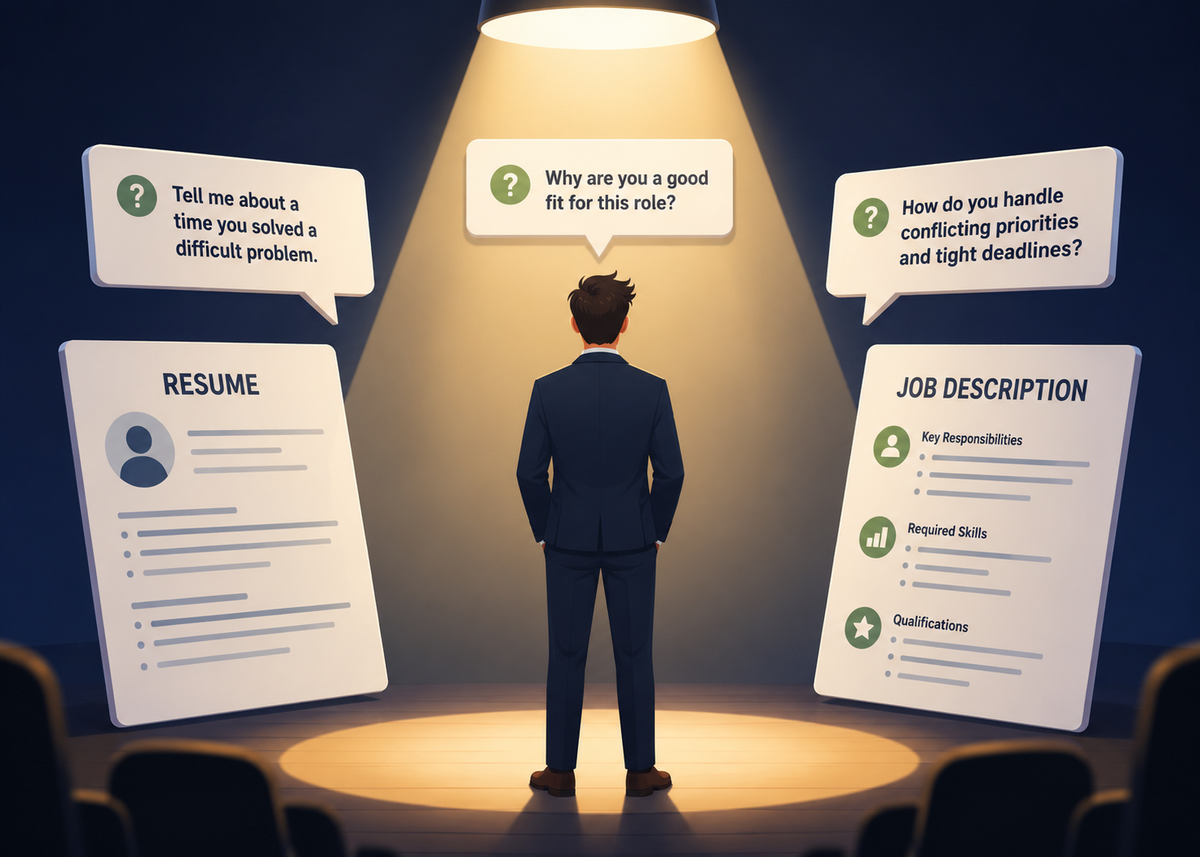
An interview isn't simply a conversation about your experience. It's a structured evaluation of how well your experience aligns with a specific role. The questions being asked are rarely random. They're designed to explore the exact responsibilities, challenges, and priorities described in the job posting.
That means the context matters.
A candidate interviewing for a project management role may be asked about stakeholder communication, risk management, and competing priorities. The same candidate interviewing for an operations role could face entirely different questions, even if much of their experience overlaps. The details of the position shape the conversation.
Yet many candidates prepare in a generic way.
They review common interview questions. They rehearse a short summary of their background. They spend time thinking about what they want to say, but relatively little time thinking about what they're likely to be asked.
The result is a mismatch.
The candidate knows the material, but not the test.
It's similar to applying for jobs with the same resume every time. The problem isn't a lack of effort. It's a lack of alignment.
Interview preparation works best when it is tied directly to the opportunity itself.
The strongest candidates don't just prepare answers. They prepare for that interview. They understand the role, the language used in the job description, the responsibilities being emphasized, and the kinds of situations the employer is likely trying to evaluate.
That preparation changes the conversation.
Answers become more relevant. Examples become easier to recall. Confidence increases because the candidate isn't trying to improvise under pressure. They're responding to scenarios they've already considered.
The irony is that interviews are often the highest-leverage part of the entire job search, yet they're frequently the least structured.
Applications are tracked. Resumes are reviewed. Job descriptions are analyzed.
Then the interview arrives and preparation becomes informal.
A quick review of the company website. A few practice questions. A promise to "just be yourself."
Sometimes that's enough.
Often it isn't.
The difference between a good interview and a great interview is rarely experience alone. It's preparation that is specific to the role, the company, and the conversation that's about to happen.
That's why interview preparation should be treated as part of the same system as the rest of the job search.
The goal isn't to memorize answers or sound scripted. It's to reduce uncertainty. To identify likely questions before they're asked. To practice responding in a way that reflects both your experience and the requirements of the role.
This is exactly why we built Trackplicant's Role-Specific Mock Interviews.
Instead of practicing generic interview questions, you can prepare against the actual job you're pursuing. The interview is generated using the job description, your resume, and the context of the role, creating a more realistic rehearsal for the conversation you're likely to have.
Because landing an interview isn't the finish line.
It's the moment when preparation becomes even more important.
A great application gets you into the interview.
A great interview is what moves you beyond it.