
Why Most Resumes Don’t Work (Even When They’re “Good”)
Most resumes don’t fail because they’re bad—they fail because they’re not specific enough. In a crowded hiring process, relevance matters more than general quality.

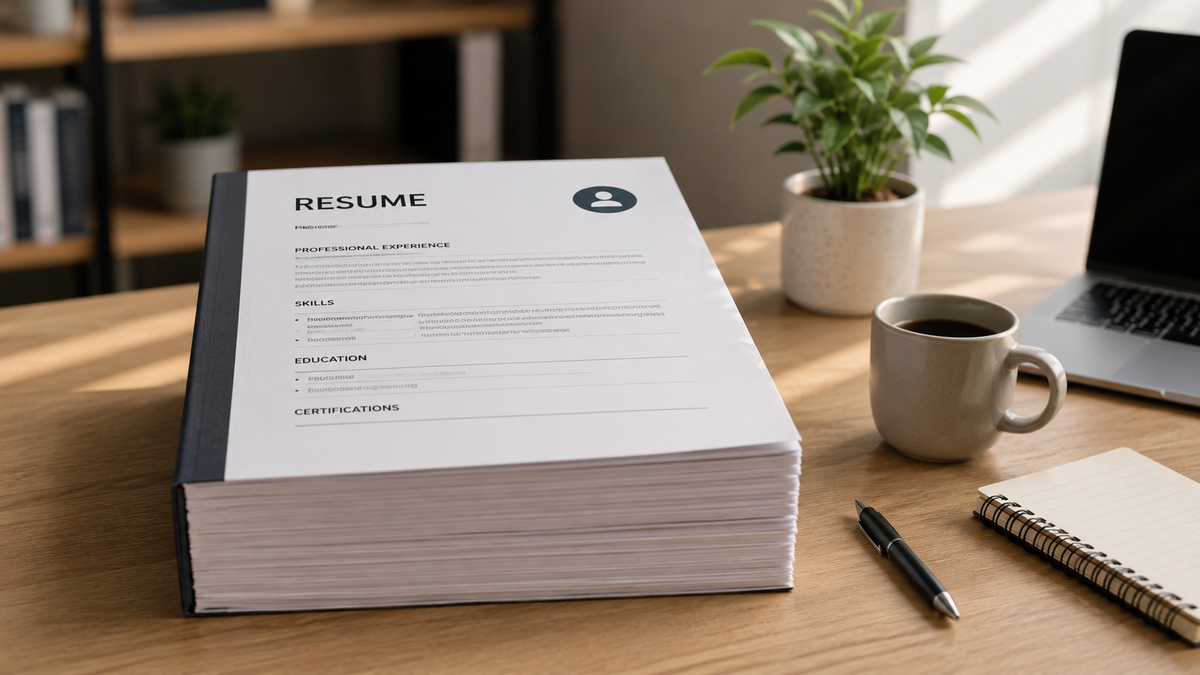
Most resumes fail quietly.
Not in obvious ways. Not because they’re poorly written or completely off-target, but because they don’t create enough separation to stand out in the context they’re used in. From the candidate’s perspective, the document looks solid. It’s clear, well-structured, and reflects their experience accurately. From the outside, there’s no clear reason it shouldn’t work.
And yet, it often doesn’t.
The problem is that resumes aren’t evaluated in isolation. They’re evaluated alongside dozens, sometimes hundreds, of others that are also clear, also structured, and also “good.” In that environment, quality becomes a baseline rather than a differentiator. Meeting that baseline is necessary, but it doesn’t meaningfully influence the outcome on its own.
What matters is whether the resume makes its relevance immediately obvious.
That distinction is easy to overlook because it isn’t about adding more content or improving how something is written. It’s about reducing the amount of interpretation required on the other side. A resume that aligns closely with the language, priorities, and structure of a specific role is easier to process. The connection between the candidate’s experience and the job’s requirements is visible without effort.
When that connection isn’t clear, even a strong resume can stall. Not because it’s incorrect, but because it requires too much translation. In a process where time and attention are limited, anything that slows understanding works against the candidate, regardless of how capable they are.
This is where the idea of a “good resume” becomes misleading. A document can be well-crafted and still underperform if it isn’t tightly aligned to the role it’s being used for. The gap isn’t in quality; it’s in specificity.
Most job searches don’t account for that difference. The assumption is that once a resume reaches a certain level of quality, it can be reused across similar roles with only minor adjustments. At first, that approach seems efficient. It allows more applications to be submitted in less time, and it avoids the overhead of starting from scratch for each opportunity.
Over time, though, that efficiency comes at a cost.
As the same version of a resume gets reused across different contexts, the level of alignment gradually decreases. Small differences between roles—differences that matter in evaluation—are smoothed over. The document remains broadly accurate, but less directly connected to any specific opportunity. From the candidate’s perspective, the resume still looks strong. From the hiring side, it looks less relevant than it could be.
This is why so many resumes end up competing on the same level. They meet the baseline, but they don’t move beyond it. The result isn’t rejection in a clear sense, but a lack of movement. The application doesn’t stand out enough to be prioritized, and in a process driven by limited attention, that’s often the deciding factor.
The natural response is to keep refining the document, to make it stronger in general terms. But general strength isn’t what changes outcomes in this context. What changes outcomes is the ability to make the resume feel specific to the role it’s being used for, consistently, across multiple applications.
That’s where the process usually breaks down.
Tailoring a resume effectively takes time and attention, and maintaining that level of effort across a full job search is difficult. As the number of applications grows, the pressure to move faster increases, and the level of specificity decreases. The intent to tailor remains, but the execution becomes inconsistent.
At that point, the problem isn’t understanding what to do. It’s being able to do it repeatedly without losing quality.
This is the gap we focused on with Trackplicant. Not simply improving resumes in general, but making it possible to generate ATS-friendly versions that are tailored to each specific job description as part of the application process itself. The goal isn’t to create a single document that works everywhere, but to maintain alignment where it actually matters.
Because once resumes are treated as dynamic rather than static—something that adapts to the role instead of trying to cover all roles at once—the way they perform begins to change. They become easier to evaluate, easier to compare, and more likely to move forward in a process that depends on quick, clear decisions.
If your resume isn’t producing the results you expect, it’s worth looking beyond how it reads and considering how it’s being used.
Because in most cases, the issue isn’t that it isn’t good.
It’s that it isn’t specific enough.