
Why Job Searching Gets Harder the Longer It Lasts
Long job searches don't just test your patience—they drain your ability to make good decisions. Here's why decision fatigue matters, and how having the right system helps you stay effective from the first application to the last.

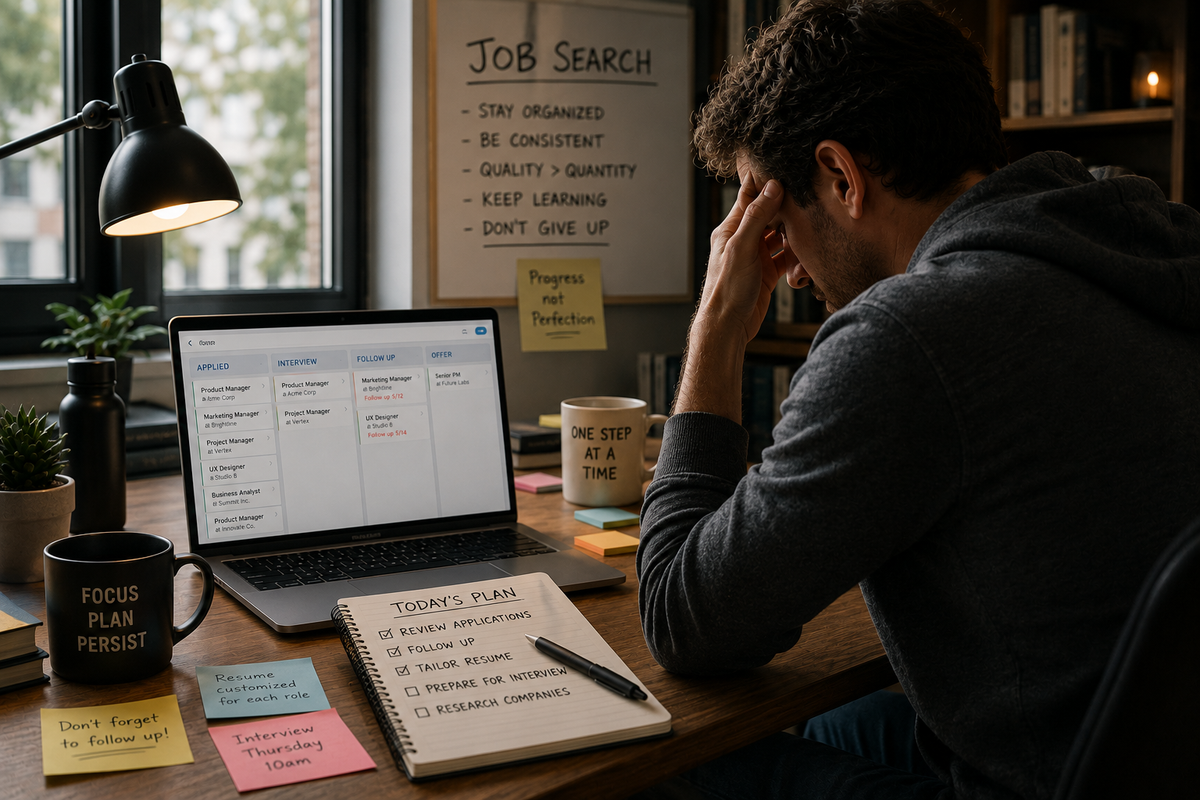
When people imagine a job search, they almost always picture the beginning.
There's a certain optimism that comes with updating your resume for the first time, polishing your LinkedIn profile, and opening a job board full of possibilities. Every opportunity feels like it could be the one. You spend time reading job descriptions carefully, researching companies, and imagining what life might look like if this particular role became your next chapter. Even though searching for a new job can be stressful, there's also an undeniable sense of momentum. You're moving forward.
What almost nobody talks about is what happens after the excitement wears off.
Six weeks later, the routine begins to change. The job descriptions start to blur together. Companies you've never heard of begin to sound strangely familiar. You've rewritten your resume more times than you can remember, answered the same application questions dozens of times, and developed a browser full of tabs that you keep meaning to revisit. Nothing dramatic has happened. There hasn't been one particularly bad day. Instead, the search has simply become... heavier.
That's because a long job search isn't just emotionally exhausting.
It's mentally exhausting.
Psychologists use the term decision fatigue to describe what happens when our ability to make thoughtful decisions gradually declines after making too many of them. It's a phenomenon that's been studied in everything from medicine to finance. Judges have been shown to make different decisions depending on how mentally fresh they are. Consumers become more impulsive after spending hours comparing products. Even experienced professionals begin relying on shortcuts when they're forced to make too many choices without a break.
A job search creates exactly the kind of environment where decision fatigue thrives.
Think about how many decisions you're making every single day.
Should I apply for this position?
Do I meet enough of the requirements?
Should I rewrite my resume again?
Is this company worth researching?
Should I follow up today or wait another two days?
Would this salary actually be enough if I had to relocate?
Individually, none of those questions feels overwhelming. In fact, each one seems fairly reasonable. The problem is that they don't happen in isolation. They arrive one after another, day after day, week after week, until your brain quietly begins looking for ways to conserve energy.
That's when your job search starts to change.
Not because you've become lazy.
Not because you've stopped caring.
Because your mind is trying to become more efficient.
You begin skimming job descriptions instead of reading them carefully. Applications become increasingly generic because tailoring every resume feels like too much work. You tell yourself you'll remember to follow up with that recruiter tomorrow, only to realize a week has passed. Jobs get saved with good intentions but never revisited. Eventually, you're spending just as much time searching as you did when you started, but you're making fewer thoughtful decisions along the way.
Ironically, this is often the stage where people become most critical of themselves.
They assume they're losing motivation. They wonder why they're procrastinating. They promise themselves they'll work harder tomorrow. Productivity blogs tell them to wake up earlier, eliminate distractions, or simply become more disciplined.
Those suggestions aren't necessarily wrong.
They're just addressing the wrong problem.
The issue usually isn't effort.
It's cognitive overload.
There's a reason highly skilled professionals rely on systems instead of memory. Airline pilots don't perform pre-flight checks from memory because they're inexperienced; they use checklists because experience has taught them that memory becomes less reliable as complexity increases. Surgeons follow structured procedures before operations. Engineers use documented processes. Professional kitchens run on systems that ensure dozens of moving parts stay coordinated even during the busiest service.
The more complicated the work becomes, the more valuable a good system becomes.
Job searching deserves the same level of discipline.
After all, you're managing applications, recruiters, interviews, follow-ups, resumes tailored to different positions, cover letters, deadlines, company research, and increasingly important career decisions. Expecting yourself to remember all of that while also making consistently good decisions isn't realistic. Eventually, something slips—not because you're incapable, but because you're human.
That's one of the reasons Trackplicant was built as a job search operating system instead of simply another application tracker. Suggested Jobs reduce the time spent searching. The Feed surfaces what needs your attention next. Follow-up reminders remove the burden of remembering every conversation. AI-powered resume tools, cover letters, and Practice Interviews help you prepare without forcing you to start from scratch each time. The goal isn't to replace your judgment. It's to preserve it by removing as much unnecessary mental overhead as possible.
Because the longer your job search lasts, the more valuable your attention becomes.
Protecting it isn't a luxury.
It's part of the strategy.