
What Is Trackplicant? (And Why It’s Not Another Job Tool)
Most job tools focus on helping you find more jobs or improve your resume. Trackplicant takes a different approach—treating your job search as a system so you can make better decisions, stay organized, and improve outcomes over time.

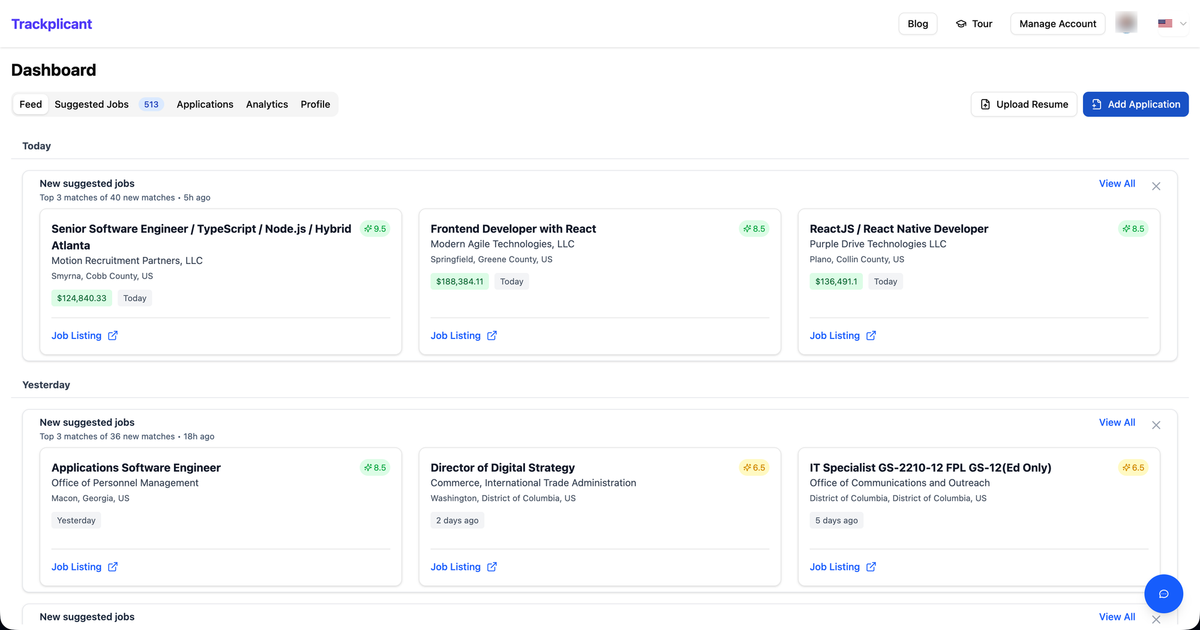
Most tools in the job search space are built around a single assumption: that the problem is access.
If you can find more jobs, apply faster, or generate better documents, the thinking goes, the results will follow. That assumption has shaped an entire category of products—job boards that surface more listings, auto-apply tools that increase volume, and resume platforms that focus on improving a single artifact in isolation.
At first glance, it seems logical. More opportunities should increase your chances. Better materials should improve your odds. And in small doses, both of those things can help.
But they don’t address the part of the process where most outcomes are actually determined.
A job search isn’t a discovery problem. It isn’t even primarily a document problem. It’s an execution problem that unfolds over time, across multiple opportunities, each requiring decisions, follow-through, and context to move forward.
That’s the gap most tools leave behind.
They optimize for individual actions—finding, applying, editing—without connecting those actions into a system that can be managed, observed, and improved. The result is a process that generates activity, but not necessarily progress. Applications are submitted, resumes are updated, and new roles are identified, but the underlying structure doesn’t change.
Trackplicant was built around a different assumption.
Instead of focusing on individual steps, it treats the job search as a system that needs to be operated. Every application is part of a pipeline. Every decision affects what happens next. Every action—whether it’s choosing a role, tailoring a resume, or following up—has value only in the context of the broader process.
That shift changes what the product is trying to do.
It isn’t trying to help you apply to more jobs. It’s trying to help you make better decisions about which jobs to pursue in the first place, and then manage those opportunities in a way that gives them a real chance to progress. It isn’t trying to create a single “perfect” resume. It’s making it possible to generate an ATS-friendly version that is aligned to each specific role, as part of the application you’re already tracking.
The difference is subtle at first, but it compounds quickly.
When your job search is treated as a set of disconnected actions, each one has to succeed on its own. When it’s treated as a system, those actions begin to reinforce each other. Better job selection improves the quality of applications. Better alignment improves how those applications are evaluated. Consistent follow-up keeps opportunities active long enough to move forward.
What changes isn’t just what you do, but how those actions interact.
This is why Trackplicant doesn’t fit cleanly into the categories people expect. It isn’t a job board, even though it surfaces opportunities. It isn’t a resume tool, even though it helps you tailor your resume for each role. And it isn’t an automation platform, because it doesn’t try to remove you from the process.
It’s closer to an operating system for your job search.
Not something that replaces the work, but something that structures it—so that every action is connected, every opportunity is visible, and the entire process can be improved over time instead of repeated.
That distinction matters because it reframes what success looks like.
The goal isn’t to apply to more jobs. It’s to move the right opportunities forward. It isn’t to create a better document once. It’s to maintain alignment across every application. It isn’t to rely on automation to increase output. It’s to build a process where effort compounds instead of resetting with each new role.
If you’ve used other job tools, the difference becomes clear quickly.
Not in what’s available, but in how it behaves.
Because the problem isn’t that there aren’t enough tools.
It’s that most of them are solving the wrong part of the problem.