
How Your Job Search Changes When You Stop Treating It Like a To-Do List
Most job searches are managed like a to-do list—apply, update, repeat. But that approach breaks down quickly. Real progress comes from treating your job search like a system, where every opportunity, decision, and next step is connected.

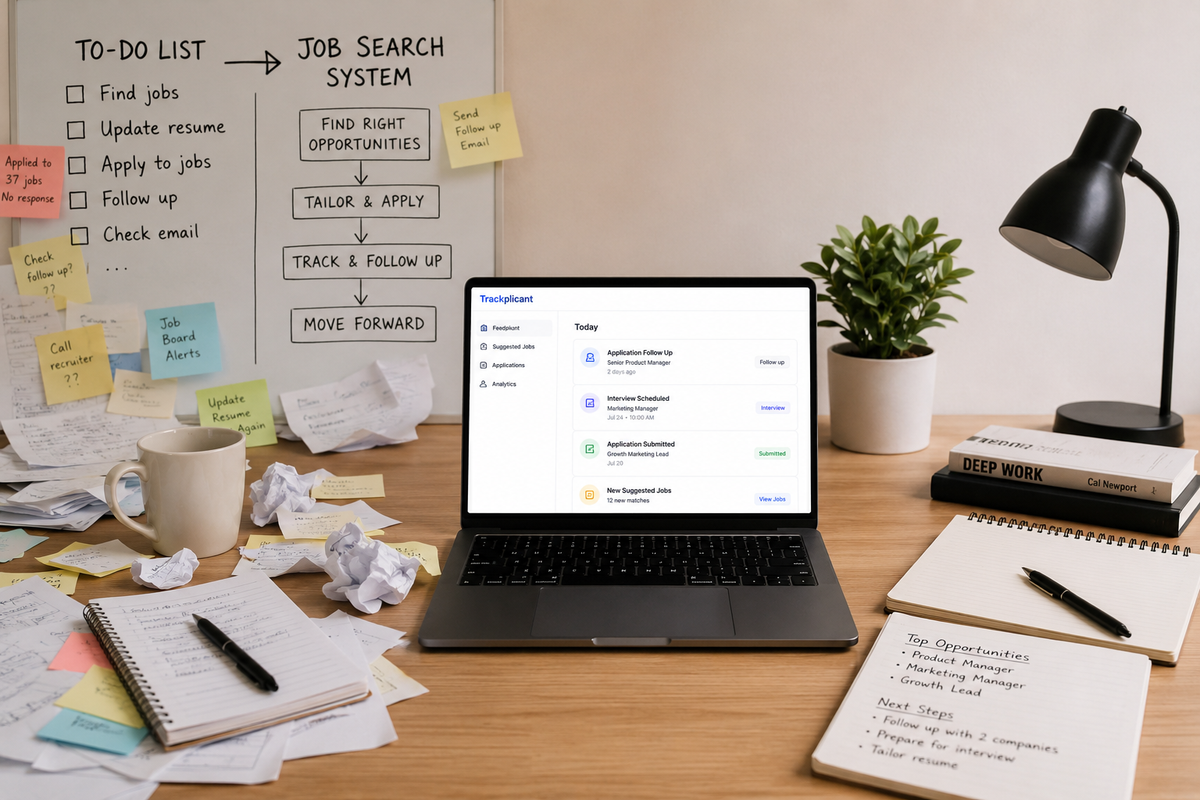
Most job searches start the same way.
You open a few job boards, scan through listings, and begin applying to anything that seems like a reasonable fit. Each application is treated as a task to complete—something you can check off and move past. The goal is to keep moving, to maintain momentum, to feel like progress is being made.
For a while, that approach works well enough.
There’s a sense of activity. Applications go out. New roles are discovered. Time is being invested. But as the process continues, something begins to shift. The number of applications increases, but the clarity around what’s happening does not. It becomes harder to remember where you’ve applied, what stage each opportunity is in, and what should happen next.
At that point, the job search starts to feel less like progress and more like maintenance.
This is the limitation of treating the process like a to-do list. A list is designed to track completed actions, not evolving situations. It tells you what you’ve done, but not what’s happening. It captures activity, but not state. And without a clear sense of state, it becomes difficult to manage anything beyond the next immediate step.
That’s why so many job searches begin to stall after an initial burst of effort. Not because there’s nothing left to do, but because the structure needed to support continued progress isn’t there.
What changes when you move away from that model isn’t the amount of work required. It’s how that work is organized.
Instead of thinking in terms of tasks, the focus shifts to opportunities. Each application is no longer something you’ve completed, but something that exists in a particular state—waiting, progressing, stalled, or in need of follow-up. That distinction creates context, and with context, the next step becomes clearer.
You’re no longer asking, “What should I do next?” in a general sense. You’re asking, “What does this opportunity need?”
That shift seems small, but it changes the experience of the entire process.
Decisions become more grounded. Follow-ups happen at the right time because they’re tied to something specific, not based on memory or guesswork. Opportunities that would have been forgotten remain visible long enough to move forward. The process stops feeling reactive and starts to feel directed.
Over time, that structure creates something that is difficult to achieve in a task-based approach: continuity.
Each action builds on the last. Effort compounds instead of resetting with every new application. Progress becomes easier to see, not because more is happening, but because what is happening is connected.
This is also where other parts of the job search begin to behave differently. When you’re working within a system, it becomes easier to maintain alignment between your resume and the roles you’re applying to, because each application already exists within a defined context. It becomes easier to evaluate which jobs are worth pursuing, because you can see how similar opportunities have progressed. It becomes easier to manage your time, because you’re no longer spreading effort evenly across everything.
The process doesn’t necessarily become simpler, but it becomes more coherent.
That coherence is what most job searches are missing. Not more effort, not more tools, but a structure that allows everything being done to connect and move forward together.
This is the shift Trackplicant is designed to support.
Not by replacing the work, but by organizing it in a way that makes it possible to operate your job search as a system rather than a sequence of disconnected tasks. When every opportunity has a place, every stage is visible, and every action is tied to what comes next, the process stops relying on momentum alone.
It becomes something you can manage.
Because a job search isn’t a list of things to finish.
It’s a process that needs to be run.